💰 Learn how to earn steady, hands-off returns backed by real estate.
Get weekly updates & education straight to your inbox!
Read and Recommended by Top Industry Professionals
"This newsletter explains note investing in a clear and practical way. It focuses on how deals actually work, not theory or hype. The breakdowns are easy to follow and useful whether you are new to notes or already investing."- James R.
"I like how straightforward The Debt Investor newsletter is. It walks through note investing step by step and explains the risks, returns, and structure clearly. Everything is written in plain language and feels grounded in real experience."- Daniel H.
"The Debt Investor newsletter does a good job simplifying a complicated topic. Each issue is easy to read and focuses on the fundamentals that actually matter. It has helped me better understand how to evaluate and think about notes."- Gabby M.
"This newsletter is clear, practical, and easy to follow. It explains note investing without jargon and focuses on real-world scenarios. I find it useful as both a learning resource and a reference when thinking through deals."- Brian T.
"What I appreciate most is how consistent and focused The Debt Investor is. It explains note investing in a simple, logical way and avoids unnecessary noise. Every issue feels intentional and informative."- Alex P.
"The content is well-written and easy to understand. It breaks down note investing into manageable concepts and explains why things work the way they do. It has been a helpful addition to my investing education."- Ryan K.
About The Debt Investor™
The Debt Investor™ is the easiest way to understand how to earn steady, hands-off returns by investing in mortgages. No confusing finance jargon. Just clear, practical insights anyone can follow.We deliver one focused email every week with straightforward education on note investing, real deal breakdowns, and the strategies investors use to generate consistent, real-estate-backed income.You can also view our FREE course HERE. It is in-depth and answers the questions most people have when getting started.Each issue cuts through the noise and gives you actionable guidance, simple explanations, and behind-the-scenes looks at real note opportunities. The goal is to help you become a smarter and more confident debt investor.
Popular Posts
What Is a Note?In simple terms, a note is a straightforward promise to pay back money. Think of it like this: if you lend someone cash to buy a property, that borrower signs a note that lays out exactly how they’ll pay you back...
Notes V. Rentals, which one wins?Many investors start with rentals because it feels familiar. You buy a house, rent it out, and collect rent every month. On paper, it looks simple and logical. After a few years, many landlords feel worn down. Tenants...
5 Myths About NotesNotes are often misunderstood. Many investors hear negative things about notes before they ever learn how they actually work. These ideas usually come from myths, not experience. When you break those myths down one...
Frequently Asked Questions
Subscribe Now
Get weekly updates & education straight to your inbox!
Get Access To Our FREE Note Investing Course
Learn how note investing works, how investors create monthly cash flow, and why many people prefer owning debt instead of dealing with rentals.
Learn How To Turn Your Home Equity Into Consistent Cash Flow
Unlock Monthly Cash Flow From Your Home Equity
Learn how people just like you use their home equity to create consistent monthly cash flow.
Learn how people just like you use their home equity to create consistent monthly cash flow.
Your Home Equity Could Be Producing Income
Learn how people just like you use their home equity and real estate notes to create consistent monthly cash flow.
What If Your House Could Help Pay For Itself?
Learn how people just like you use their home equity and real estate notes to create consistent monthly cash flow.
Use Your Home Equity To Create Cash Flow
Learn how people just like you use their home equity and real estate notes to create consistent monthly cash flow.
Turn Your Home Equity Into Consistent Cash Flow
Most homeowners have a large amount of equity sitting inside their home doing absolutely nothing.In this training, we break down how some investors are using that equity to create monthly cash flow instead of letting it sit idle. We’ll walk through the basic structure, how the numbers work, the risks involved, and why real estate backed debt has become an attractive alternative to investments for most investors.This isn't about flipping houses, dealing with tenants, or becoming a landlord. It’s about understanding how debt backed by real estate works and how monthly cash flow can be created from it.Whether you’re completely new to this or just looking for another way to think about your equity, this training is designed to make the process simple and easy to understand.
How We Get 10-12% Returns Without Tenants Or Toilets
Learn how we use real estate backed notes to create predictable monthly cash flow without managing properties
Free Training: How We Get 10-12% Returns Without Tenants Or Toilets
Learn how we use real estate backed notes to create predictable monthly cash flow without managing properties
💰 Learn how to earn steady, hands-off returns backed by real estate.
Get weekly updates & education straight to your inbox!
💰 Learn how to earn steady, hands-off returns backed by real estate.
Get weekly updates & education straight to your inbox!
Join Our Note Buyers List.
Be the first to see new mortgage note opportunities.
Get Access To Our Free 'STACK' Method
We use STACK to find, analyze & acquire note deals. It gives you an overview of everything you need to know from A-Z.
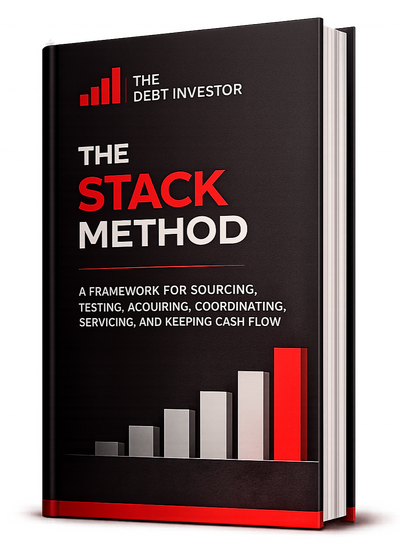
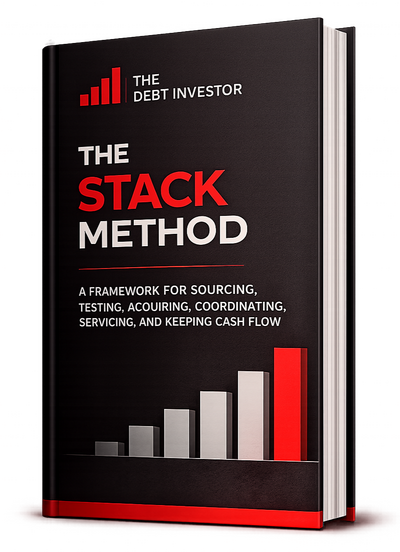
Get Access To Our Free 'STACK' Method
We use STACK to find, analyze & acquire note deals. It gives you an overview of everything you need to know from A-Z.
Get Access To Our Free Cashflow Calculator
The STACK Method
A beginners guide to note investing
If you’re brand new to notes, this guide will help simplify the entire process.A lot of people hear “note investing” and immediately think it sounds complicated. In reality, a note is just debt. Somebody borrowed money and agreed to pay it back over time. When you buy a note, you’re buying the right to collect those payments. That’s it.You’re not swinging hammers. You’re not fixing toilets. You’re not dealing with tenants calling you at 2 a.m. because the water heater exploded. You’re owning the debt instead of the property.The system we use to evaluate and manage notes is called the STACK Method:1. Source the deal
2. Test the deal
3. Acquire the deal
4. Coordinate servicing
5. Keep cashflowingBefore we break down the STACK Method, let’s quickly cover a few basics.Note Investing BasicsWhat Is a Note?A note is made up of two main documents. The first is the promissory note. This outlines the loan terms like the interest rate, payment amount, loan balance, payment schedule, and loan length. Think of this as the IOU.The second document is the security instrument, which is either the mortgage or deed of trust depending on the state. This is what ties the debt to the property itself. If the borrower stops paying, the lender has legal rights against the property. That’s what makes real estate-backed notes very different from unsecured debt.Performing vs Non-Performing NotesA performing note means the borrower is making payments on time. This is what most beginners start with because the cash flow is already coming in.A non-performing note means the borrower has stopped paying. These can sometimes be bought at larger discounts, but they usually require more experience because workouts, foreclosure, or restructuring may be involved.Amortized vs Interest-Only LoansAn amortized loan means every payment includes both principal and interest. Over time, the balance gets smaller. This lowers your loan-to-value ratio over time, which naturally reduces risk. This is our preferred structure.An interest-only loan means the borrower only pays interest during the loan term. The balance does not go down, which means your risk stays roughly the same the entire time. Interest-only loans can still work, but we generally prefer amortized loans because they reduce exposure over time while still producing strong cash flow.
What is 'STACK'?
The STACK MethodS = Source The DealThis is where you actually find notes. A lot of beginners think finding deals is the hard part, but there are actually quite a few ways to source them.1. Create Your Own NotesThis is one of the most powerful ways to source deals because you control the structure from the beginning. One common example is seller financing.Let’s say you buy a property for $100,000. Maybe the property is worth around $110,000, so you bought it at a small discount. Instead of selling the house for cash, you sell it with financing.You sell it for:
- $125,000
- 8% interest
- 30-year amortizationThat creates a payment of roughly $917 per month.Now instead of just selling a house, you created a long-term cash-flowing asset.You can also create notes by funding another investor’s deal. Maybe another investor has a strong deal but needs capital. You underwrite the deal, make sure it fits your risk criteria, and fund it.2. Facebook GroupsThere are many real estate investing Facebook groups where notes are posted regularly. The downside is competition. A lot of these deals are relationship-driven, so networking matters.3. Conferences and Networking EventsThis is where active buyers and sellers connect. A lot of note deals happen because somebody knows somebody. Networking still matters in this business.4. Local and Regional BanksBanks sometimes sell loans directly, especially smaller regional and community banks. You can often reach out to their asset management departments, workout departments, special assets departments, or servicing departments to see if they have loans for sale. Some of these loans may be non-performing.5. Online Marketplaces and BrokersThere are online marketplaces where notes are listed with details like balances, payment history, interest rates, collateral information, and property details. This makes deals easy to review. Some examples include Paperstac, NotesDirect, and LoanMLS.6. Direct Outreach to Current Note OwnersYou can also pull lists of current note owners and contact them directly through cold calls, direct mail, or email outreach. This can create less competition because you’re reaching owners before the deal ever hits the market. The downside is it requires time, consistency, marketing, and upfront cost.7. Curated Deal FlowAt The Debt Investor™, we curate note opportunities and educational breakdowns and send them directly through our newsletter. Instead of sorting through hundreds of deals yourself, we help simplify the process and highlight deals worth reviewing.T = Test The DealThis is underwriting. This is where risk is managed.A lot of beginners think note investing is risky because borrowers can default. The truth is most bad outcomes happen because somebody bought a bad deal. The goal is not to eliminate risk completely. The goal is to understand it before you buy.We use four main pillars when testing a deal.Pillar 1: Low Loan-To-Value (LTV)Loan-to-value measures how much debt exists compared to the property value.Formula:
LTV = Loan Balance ÷ Property ValueExample:
- Property Value = $100,000
- Loan Balance = $70,000$70,000 ÷ $100,000 = 70% LTVLower LTV generally means lower risk because there is more equity protecting the lender. We generally prefer 70% LTV or lower.Pillar 2: Strong Borrower PerformanceIf the loan already exists, we want good payment history and consistent payment behavior. If we are originating the loan ourselves, we want both the ability and intention to repay.Ability means they can afford the payment. Intention means they actually want to pay. Both matter.If it’s an investment property, we also want strong DSCR.DSCR stands for Debt Service Coverage Ratio. It measures whether the property income supports the debt payment.Formula:
DSCR = Net Operating Income ÷ Annual Debt PaymentsExample:
- Property produces $1,500/month net income
- Loan payment is $1,100/month$1,500 ÷ $1,100 = 1.36 DSCRWe generally prefer a DSCR of 1.25 to 1.30 or higher.Pillar 3: Solid CollateralWe want good collateral. We do not want war zones, severely declining areas, junk properties, or assets that rapidly depreciate. We generally avoid mobile homes because they tend to depreciate over time.A property needing cosmetic rehab is fine. A collapsing property in a terrible area is a different story. The collateral matters because it’s your backup plan if things go wrong.Pillar 4: Strong ReturnThe deal still needs to fit your target return. Maybe your target yield is 6%, 8%, 10%, or 12%. Whatever your target is, the numbers need to work.You can calculate note yields using amortization calculators, spreadsheet models, financial calculators, or online note calculators.One important thing to understand is this: the interest rate on the loan is not always your yield. If you buy a note at a discount, your yield may actually be much higher than the stated interest rate.A = Acquire The DealThis is the closing process. This is where ownership officially transfers.Every state is different, but we strongly prefer using closing attorneys, title companies, or escrow services. Good professionals cost money. Bad deals cost far more.A good closing attorney can help verify documents, review collateral, confirm assignments, ensure proper transfers, and reduce legal mistakes. This is not the place to cut corners.C = Coordinate ServicingOnce you own the note, somebody has to handle collecting payments, sending statements, tracking balances, managing escrow, handling late payments, and tax reporting. That’s what servicing companies do.Some investors self-service, while many use third-party servicers. A good servicer creates separation between you and the borrower while keeping records organized.Some common servicing companies include:
- Madison Management
- Allied Servicing
- FCI Lender ServicesK = Keep CashflowingThis is the part most people actually want. The payment shows up every month.You’re not dealing with tenant turnover, leaky toilets, midnight maintenance calls, damaged carpet, or managing contractors. You’re collecting payments on debt.That doesn’t mean notes are risk-free. Nothing is.Borrowers can default. Foreclosure can happen. Bad underwriting can create problems.But strong underwriting, low leverage, proper servicing, and buying the right collateral can dramatically reduce risk before you ever buy the deal. That’s why the “Test The Deal” step matters so much. Most risk is managed before the wire ever gets sent.Final ThoughtsA lot of people spend years researching notes without ever buying one because they think the business is more complicated than it really is.At the end of the day, note investing comes down to:
- Sourcing deals
- Testing the deal
- Acquisition
- Coordinate servicing
- Keep collecting cashflowThat’s the STACK Method.If you want to learn more about notes, check out our free course HEREEducational purposes only. This is not financial, legal, or tax advice. Always perform your own due diligence before purchasing any investment.
What Is a Note?
In simple terms, a note is a straightforward promise to pay back money. Think of it like this: if you lend someone cash to buy a property, that borrower signs a note that lays out exactly how they’ll pay you back over time. It’s all about turning your money into steady returns.There are two main types of notes. An interest-only note means the borrower pays just the interest at first, so you’re earning a steady stream of interest payments while the principal stays the same for a while. An amortized note is different: each payment reduces both the interest and the principal, the original sum borrowed, until the loan is fully paid off.From a legal standpoint, a note is a binding document that says exactly who owes what and under what conditions. For an investor, that means you’ve got a solid way to earn money without having to deal with all the hassles of managing a property. You lend out your funds, and you collect returns through the interest that the borrower pays you.In other words, it’s a real, practical way to make your money work for you. Keep an eye on the term (how long the note lasts), the interest rate (your profit margin), and the principal balance (the remaining amount to be paid back).If you’re ready to see how notes can help you grow your portfolio, subscribe to our newsletter HEREDisclaimer: Educational purposes only. Not financial advice. Do your own research.
Notes V. Rentals, which one wins?
Many investors start with rentals because it feels familiar. You buy a house, rent it out, and collect rent every month. On paper, it looks simple and logical.After a few years, many landlords feel worn down. Tenants stop paying. Repairs pop up at the worst time. Vacancies kill cash flow. Phone calls come late at night. That is usually when investors start asking a better question. Is there a way to invest in real estate without owning property?That's where notes come in.A rental is a property you own. You are the landlord, and your income comes from rent paid by a tenant. Your success depends on the tenant paying on time, the property staying occupied, and repairs not destroying your profit. If any one of those breaks, the numbers change fast.Consider a simple example. You buy a house for $200,000 and put $40,000 down. The rent is $1,600 per month. After the mortgage, taxes, insurance, and basic repairs, you might net around $400 per month. That sounds fine until the air conditioner fails, the roof leaks, or the tenant moves out. Rental income is tied to people, property, and problems.A note is different. A note is a loan backed by real estate. Instead of owning the house, you own the debt. The borrower owns the property and makes payments to you. You collect principal and interest every month. There are no tenants, no toilets, and no repairs.Here is a simple note example. You buy a note for $40,000. The borrower pays you $500 per month. That's $6,000 per year in cash flow (with no repairs, tenants, late night calls etc.) The return is roughly 15 percent before costs. You didn't buy a house, you bought income.The workload between rentals and notes is very different. With rentals, you manage people and property. That includes leasing, maintenance, repairs, insurance issues, vacancies, and sometimes evictions. Even if you hire a property manager, you still make decisions and handle problems. Rentals are not passive.With notes, you manage paper. Most note investors use a loan servicer. The servicer collects payments, sends statements, and handles basic borrower communication. You review reports and collect income. Notes are MUCH closer to passive than rentals.Predictable cash flow is important to investors. Rental income can change often. Rent increases are slow, but expenses can jump overnight. One major repair can wipe out months of cashflow. A vacant month not only means zero cashflow, but negative.Note payments are fixed. The payment amount, interest rate, loan balance, and payoff date are agreed upon upfront. As long as the borrower pays, the cash flow stays steady. That predictability is a major reason investors prefer notes.No investment is risk free. Both rentals and notes have risk. The difference is when the risk shows up. With rentals, many risks appear after you buy. Unexpected repairs, bad tenants, new local rules, or rising insurance costs can hurt returns long after closing.With notes, most of the risk is handled at purchase. Before buying a note, investors review the property value, loan balance, payment history, and borrower equity. You decide whether the deal makes sense before your money goes out. Risk is managed upfront, not later.The biggest concern investors have is what happens if payments stop. It is a fair question. With rentals, if rent stops, you still owe the mortgage. You may also face eviction and property damage. The stress is personal and ongoing.With notes, missed payments are handled through a legal process. The property secures the loan. Foreclosure laws apply, and in many cases borrowers resume payments before foreclosure is complete. Foreclosure exists and it's not fun, but it is part of the math.Scalability is another key difference. Each rental is its own business. More doors mean more tenants, more repairs, and more management. Growth adds complexity fast.Notes scale better. Ten notes do not create ten times the work. The systems stay mostly the same. This is why many experienced investors move from rentals to notes over time.Owning property also brings legal and ownership exposure. Rentals involve inspections, local housing rules, liability risk, and insurance claims. Notes avoid most of this because you do not own the property. You own the loan. That simplicity matters.So which one wins? It depends on the investor. Some people enjoy being landlords. Many do not. For investors who want predictable income, less stress, fewer phone calls, and real estate exposure without ownership headaches, notes often win.Notes aren't perfect. Borrowers can default. Foreclosures exist. Nothing is guaranteed but notes offer a cleaner way to earn cash flow from real estate without owning property.The reason notes work isn't because they are exciting. They work because they are boring. Boring cash flow. Clear numbers. Defined outcomes. That is what serious investors are looking for.I'll leave you with one thought: does the bank buy notes or rental homes?If you’re ready to see how notes can help you grow your portfolio, subscribe to our newsletter HEREDisclaimer: Educational purposes only. Not financial advice. Do your own research.
5 Myths About Notes
Notes are often misunderstood. Many investors hear negative things about notes before they ever learn how they actually work. These ideas usually come from myths, not experience. When you break those myths down one by one, notes start to look very different.Myth 1 - Notes are risky and unsafe. This belief usually comes from the idea that you are lending money to someone with no protection. In reality, a real estate note is backed by property. The property is collateral, which means the borrower pledged it as security for the loan. If the borrower stops paying, the note holder has legal rights tied to that property. Risk in notes is managed at the time of purchase by buying at the right price, making sure there is equity, and understanding the loan terms. Notes are not risk free, but they are not blind bets either. The risk is structured and visible upfront.Myth 2 - You have to deal with tenants and repairs. This myth exists because people confuse notes with rentals. When you own a rental, you own the property and everything that comes with it. When you own a note, you own the debt, not the house. The borrower owns the property and handles repairs, maintenance, taxes, and insurance. If the roof leaks or the air conditioner breaks, the note holder does not get a phone call. Notes allow investors to participate in real estate without becoming landlords.Myth 3 - Notes are complicated and hard to understand. Notes sound complex because they are often explained poorly. At their core, notes are simple. Someone borrowed money and agreed to pay it back over time with interest. The payment amount is fixed. The due date is known. The interest rate is written down. Once the basics are understood, notes are often easier to manage than rentals because there are fewer moving parts and fewer ongoing decisions.Myth 4 - If the borrower stops paying, you lose everything. This myth causes more fear than almost anything else. When a borrower stops paying, the note does not disappear. The debt still exists and the lien on the property still exists. The note holder has legal options that depend on the situation and local laws. In many cases, borrowers resume payments. In other cases, the property becomes the outcome. Default is not ignored in note investing. It is expected, planned for, and priced into the deal.Myth 5 - Notes do not produce real cash flow. Some investors think notes are boring or slow. Boring is often a good thing. Notes can produce steady, predictable monthly income. Payments arrive on a schedule and the amount does not change. There are no vacancies and no surprise repair bills. Cash flow comes from interest paid by borrowers, not from hoping rents go up or values increase. Notes are built for income first, which is why many investors use them to replace or supplement rental income.In the end, notes are not perfect and they are not for everyone. Borrowers can default and legal processes exist for a reason. But many of the fears around notes come from myths that do not hold up under scrutiny. Notes offer a way to earn income from real estate without tenants, repairs, or constant management. For investors who value simplicity, predictability, and passive cash flow, notes are worth understanding before being dismissed.If you’re ready to see how notes can help you grow your portfolio, subscribe to our newsletter HEREDisclaimer: Educational purposes only. Not financial advice. Do your own research.
Car Dealers Aren’t in the Car Business. They’re Note Investors
Most people think car dealers make money by selling cars. They picture inventory on a lot, shiny paint, and quick sales. That is not the real business model for Buy Here Pay Here dealers. Their real business is the paper behind the car. The car is just the wrapper that delivers the payment.In a Buy Here Pay Here deal, the dealer sells the car and finances it themselves. The buyer does not go to a bank. They make payments directly to the dealer, often every week or every two weeks. Those payments are backed by a written contract. That contract is a note. The note is what produces income over time.Consider a simple example. A dealer sells a used car for $10,000. The buyer agrees to pay $200 every two weeks. Because there are 26 two week periods in a year, this works out to about $5,200 per year, or roughly $433 per month. If the buyer pays for four years, the dealer collects about $20,800. If the payments stretch to five years, the total collected can reach around $26,000. The dealer may have only had $7,000 or $8,000 in the car. The extra money does not come from the vehicle itself. It comes from the note.This is exactly how a note investor thinks. The dealer is not focused on how nice the car looks. They care about the structure of the deal. They care about the down payment, the payment amount, and whether the buyer can realistically pay on schedule. If the buyer pays, the dealer collects steady cash flow. If the buyer defaults, the dealer still owns the note and the collateral.Real estate notes work the same way. Someone lives in the house and makes a monthly payment. Someone else owns the note and collects that payment. The note owner does not manage the property. They are not fixing toilets or dealing with tenants. They own paper that produces income. The house is simply the collateral securing the debt.Car notes, however, come with real downsides. Cars are mobile. If a borrower defaults, the car can be hidden, damaged, or stripped for parts. Tracking it down can take time and money. Cars also lose value quickly. Mileage goes up, condition goes down, and one accident can wipe out a large portion of the value.Default rates on car notes are also higher. Many Buy Here Pay Here buyers have weak credit and unstable income. Missed payments are common. While car notes can be sold to other investors, their value depends heavily on the condition of both the borrower and the vehicle. In a worst case scenario, a repossessed car may only be worth scrap, which can be a few hundred dollars.Houses are different. A house does not move. You cannot hide it or drive it away. Even if the structure is damaged, the land still has value. Foreclosure takes longer than a car repossession, but the collateral is stronger and more stable over time. Default rates on residential mortgages are generally lower than on Buy Here Pay Here car loans.The key lesson is that notes are everywhere. People see them every day and do not realize it. Car dealers prove that owning debt can be a profitable business. They buy an asset, sell it with financing, and collect payments over time. The real value is in the paper.Real estate notes follow the same logic, but with better collateral and fewer moving parts. Notes are not risk free. Borrowers can default. Foreclosures exist. Nothing is guaranteed. But once you understand how everyday businesses already operate as note investors, real estate notes stop feeling complicated. They start to feel familiar.If you’re ready to see how notes can help you grow your portfolio, subscribe to our newsletter HEREDisclaimer: Educational purposes only. Not financial advice. Do your own research.
The Risks of Investing in Notes
Most people think car dealers make money by selling cars. They picture inventory on a lot, shiny paint, and quick sales. That is not the real business model for Buy Here Pay Here dealers. Their real business is the paper behind the car. The car is just the wrapper that delivers the payment.In a Buy Here Pay Here deal, the dealer sells the car and finances it themselves. The buyer does not go to a bank. They make payments directly to the dealer, often every week or every two weeks. Those payments are backed by a written contract. That contract is a note. The note is what produces income over time.Consider a simple example. A dealer sells a used car for $10,000. The buyer agrees to pay $200 every two weeks. Because there are 26 two week periods in a year, this works out to about $5,200 per year, or roughly $433 per month. If the buyer pays for four years, the dealer collects about $20,800. If the payments stretch to five years, the total collected can reach around $26,000. The dealer may have only had $7,000 or $8,000 in the car. The extra money does not come from the vehicle itself. It comes from the note.This is exactly how a note investor thinks. The dealer is not focused on how nice the car looks. They care about the structure of the deal. They care about the down payment, the payment amount, and whether the buyer can realistically pay on schedule. If the buyer pays, the dealer collects steady cash flow. If the buyer defaults, the dealer still owns the note and the collateral.Real estate notes work the same way. Someone lives in the house and makes a monthly payment. Someone else owns the note and collects that payment. The note owner does not manage the property. They are not fixing toilets or dealing with tenants. They own paper that produces income. The house is simply the collateral securing the debt.Car notes, however, come with real downsides. Cars are mobile. If a borrower defaults, the car can be hidden, damaged, or stripped for parts. Tracking it down can take time and money. Cars also lose value quickly. Mileage goes up, condition goes down, and one accident can wipe out a large portion of the value.Default rates on car notes are also higher. Many Buy Here Pay Here buyers have weak credit and unstable income. Missed payments are common. While car notes can be sold to other investors, their value depends heavily on the condition of both the borrower and the vehicle. In a worst case scenario, a repossessed car may only be worth scrap, which can be a few hundred dollars.Houses are different. A house does not move. You cannot hide it or drive it away. Even if the structure is damaged, the land still has value. Foreclosure takes longer than a car repossession, but the collateral is stronger and more stable over time. Default rates on residential mortgages are generally lower than on Buy Here Pay Here car loans.The key lesson is that notes are everywhere. People see them every day and do not realize it. Car dealers prove that owning debt can be a profitable business. They buy an asset, sell it with financing, and collect payments over time. The real value is in the paper.Real estate notes follow the same logic, but with better collateral and fewer moving parts. Notes are not risk free. Borrowers can default. Foreclosures exist. Nothing is guaranteed. But once you understand how everyday businesses already operate as note investors, real estate notes stop feeling complicated. They start to feel familiar.If you’re ready to see how notes can help you grow your portfolio, subscribe to our newsletter HEREDisclaimer: Educational purposes only. Not financial advice. Do your own research.
Disclaimer
© 2026 The Debt Investor™. All rights reserved.The information provided by The Debt Investor™ is for general educational and informational purposes only. Nothing contained on this website, in our newsletter, emails, social media, or other communications should be construed as financial advice, investment advice, legal advice, tax advice, or a recommendation to engage in any specific transaction or strategy.The Debt Investor™ is not a registered broker-dealer, investment adviser, financial advisor, or legal professional. Any examples, illustrations, or discussions of returns, yields, pricing, or performance are hypothetical or based on past or assumed outcomes and are not guarantees of future results.From time to time, The Debt Investor™ may present opportunities to purchase or assign individual promissory notes or debt instruments. Any such transactions are conducted on a direct, private basis and are intended for informational purposes only. These offerings are not intended to be, and should not be interpreted as, securities offerings, public solicitations, or investment advice. Participation in any transaction is voluntary and based solely on the independent judgment of the purchaser.All investments and debt instruments involve risk, including the potential loss of principal. You are solely responsible for performing your own due diligence, analysis, and evaluation of any opportunity discussed or presented. You should consult with your own legal counsel, financial advisor, tax professional, or other qualified advisors before making any investment or purchasing any note.By accessing this website or subscribing to The Debt Investor™ newsletter, you acknowledge and agree that you assume full responsibility for your investment decisions and that The Debt Investor™ shall not be held liable for any losses, damages, or outcomes resulting from the use of the information provided.
Booking Confirmed
Your call is scheduled. Talk soon!We will keep this simple. On the call, we'll walk through how notes work in real deals, what to look for before buying, how the cash flow is structured, and answer any questions you may have.Please show up on time. You will receive the call details by email. If you have not already gone through the free course, take a few minutes to review it HERE. It will make the call much more useful.These calls are for education only. We are not giving financial advice and we are not telling you what to invest in. For full details, please review our disclaimer HERE.Talk soon,
The Debt Investor™
Book A Call With The Debt Investor
Thanks for Subscribing!
You're now part of The Debt Investor community. Expect your first email soon with clear, no-fluff insights on note investing, real strategies for steady, hands-off returns backed by real estate.Want to go deeper and get personalized answers to your questions? Book a quick, no-pressure 30-minute call below. We'll walk you through how this can fit your goals.
Thanks for Subscribing!
You're now part of The Debt Investor community. Expect your first email soon with clear, no-fluff insights on note investing, real strategies for steady, hands-off returns backed by real estate.Want to go deeper and get personalized answers to your questions? Book a quick, no-pressure 30-minute call below. We'll walk you through how this can fit your goals.
Book A Call
We keep things simple. On this call, we will walk through how notes work, how deals are structured, and answer your questions. If it makes sense, we can also show you how people participate in deals by funding them. If you want a quick foundation beforehand, you can go through the free course HERE. Please show up on time. These calls are for education only. See our disclaimer HERE.-The Debt Investor™
Book A Call
We keep things simple. On this call, we will walk through how notes work, how deals are structured, and answer your questions. If it makes sense, we can also show you how people participate in deals by funding them. If you want a quick foundation beforehand, you can go through the free course HERE.-The Debt Investor™
Terms of Service
1. Purpose of the ServiceThe Debt Investor™ provides educational and informational content about note investing, real estate debt, and related financial concepts. Nothing on this website, in our emails, or through our materials constitutes financial, investment, or legal advice.2. EligibilityYou must be at least 18 years old to access or use this Service. By using it, you confirm that you meet this requirement.3. No Investment Advice or SolicitationAll content is provided for general education only.
We do not make specific investment recommendations or solicit the purchase or sale of any securities.
If investment opportunities are discussed in the future, they will be offered only to qualified investors and in compliance with applicable laws and regulations.4. Accuracy of InformationWe strive to provide accurate, current information, but we do not guarantee completeness or reliability. You agree that you use all information at your own risk.5. Intellectual PropertyAll text, images, graphics, and other content are the property of The Debt Investor™ unless otherwise noted.
You may share excerpts for educational or non-commercial use with proper credit and a link back to our website.6. Email SubscriptionBy subscribing to our newsletter, you consent to receive periodic emails from The Debt Investor™. You may unsubscribe at any time using the link included in each email.7. Limitation of LiabilityThe Debt Investor™ and its owners, partners, and affiliates shall not be liable for any loss or damages arising from the use of this Service or reliance on any information provided.8. Changes to These TermsWe may update these Terms from time to time. The date above reflects the most recent version. Continued use of the Service after updates constitutes your acceptance of the revised Terms.9. Contact UsIf you have questions about these Terms, please contact us at: [email protected]
Test Area
THIS IS A TEST AREA FOR NEW SITE FUNCTIONS. DEV USE ONLY. RETURN TO MAIN SITE TO LEARN MORE ABOUT NOTE INVESTING HERE
Start Here
Invest in Notes
Join our weekly newsletter to discover the power of note investing!
The Problem & Solution
Let's Talk Notes
Want to find out what investing in notes can do for your portfolio?Book a free 1-on-1 consultation and get all of your questions answered!
Invest in Notes
Join our weekly newsletter to discover the power of note investing!
Become The Bank
Let's Talk Notes
Want to find out what investing in notes can do for your portfolio?Book a free 1-on-1 consultation and get all of your questions answered!
Invest in Notes
Join our weekly newsletter to discover the power of note investing!
What Is A Note?
Let's Talk Notes
Want to find out what investing in notes can do for your portfolio?Book a free 1-on-1 consultation and get all of your questions answered!
Invest in Notes
Join our weekly newsletter to discover the power of note investing!
How You Get Paid
Let's Talk Notes
Want to find out what investing in notes can do for your portfolio?Book a free 1-on-1 consultation and get all of your questions answered!
Invest in Notes
Join our weekly newsletter to discover the power of note investing!
Types of Notes
Let's Talk Notes
Want to find out what investing in notes can do for your portfolio?Book a free 1-on-1 consultation and get all of your questions answered!
Invest in Notes
Join our weekly newsletter to discover the power of note investing!
Variables of a Note
Let's Talk Notes
Want to find out what investing in notes can do for your portfolio?Book a free 1-on-1 consultation and get all of your questions answered!
Invest in Notes
Join our weekly newsletter to discover the power of note investing!
Buying The Right Note
Let's Talk Notes
Want to find out what investing in notes can do for your portfolio?Book a free 1-on-1 consultation and get all of your questions answered!
Invest in Notes
Join our weekly newsletter to discover the power of note investing!
Where To Buy Notes
Let's Talk Notes
Want to find out what investing in notes can do for your portfolio?Book a free 1-on-1 consultation and get all of your questions answered!
Invest in Notes
Join our weekly newsletter to discover the power of note investing!
The Risks Involved
Let's Talk Notes
Want to find out what investing in notes can do for your portfolio?Book a free 1-on-1 consultation and get all of your questions answered!
Invest in Notes
Join our weekly newsletter to discover the power of note investing!
4 Rules of a Good Note
Let's Talk Notes
Want to find out what investing in notes can do for your portfolio?Book a free 1-on-1 consultation and get all of your questions answered!
Invest in Notes
Join our weekly newsletter to discover the power of note investing!
Case Study
FILLER PUT INTRO VIDEO HERE
Let's Talk Notes
Want to find out what investing in notes can do for your portfolio?Book a free 1-on-1 consultation and get all of your questions answered!
Invest in Notes
Join our weekly newsletter to discover the power of note investing!
Next Steps
Coming soon...
Let's Talk Notes
Want to find out what investing in notes can do for your portfolio?Book a free 1-on-1 consultation and get all of your questions answered!
Coming soon...
Invest in Notes
Join our weekly newsletter to discover the power of note investing!
Access STACK Method: HERE
Access Free Course (Videos) HERE
Book A Call: HERE
The Risks: HERE
Buyers List: HERE